
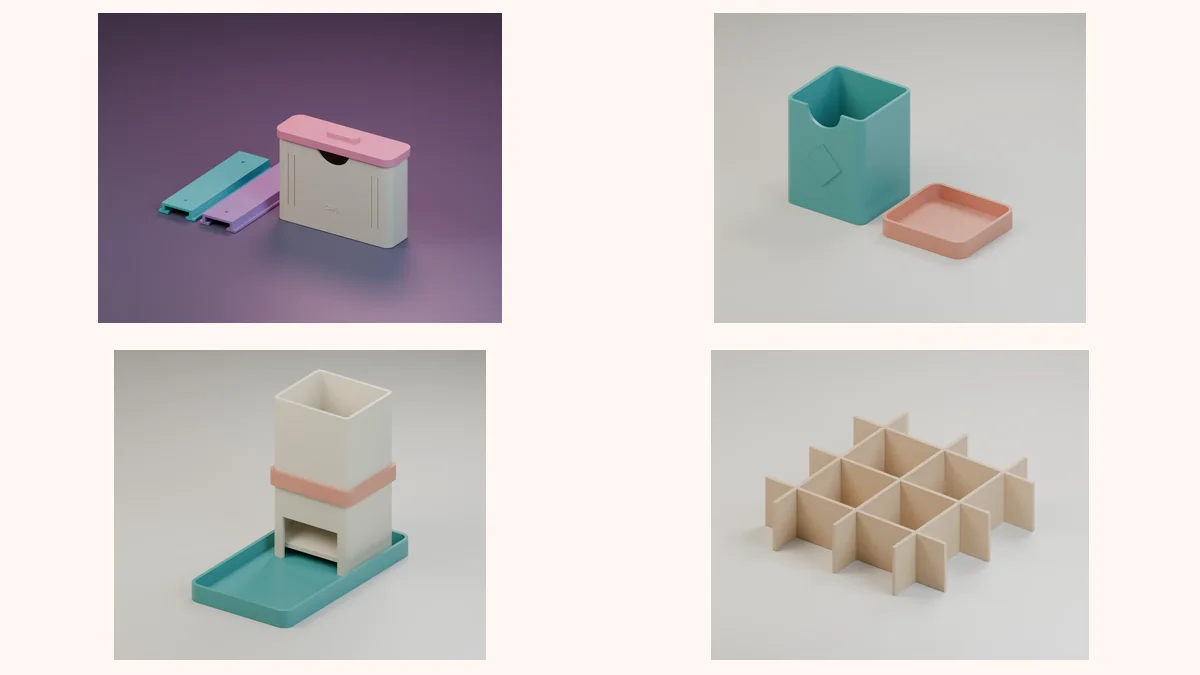
The six criteria
Before you open the slicer, run the idea through this sieve. A part that fails two of these items rarely becomes a business.
The categories that move
This isn't a list of "miracle products": it's where demand is steady and a printed part competes well with what's already on the shelf.
| Category | Why it works | Examples |
|---|---|---|
| Organization | A universal problem, a simple part, a decent ticket per set. | drawer dividers, desk organizers, cable holders |
| Kitchen and coffee | Impulse and looks-driven purchase; works as a gift. | coffee pod holders, coasters, scoops, filter organizers |
| Desk setup and office | An audience that already buys accessories and pays for finish. | headphone stands, phone stands, cable pass-throughs, laptop stands |
| Games and collecting | An active community that welcomes customization and kits. | deck boxes, dice towers, token trays, miniature stands |
| Gardening | Medium-size parts, good margin, sold in sets. | planters, pot stands, garden markers, seedling waterers |
| Replacement and utility | Urgency: people looking for a broken part buy fast. | furniture feet, drawer pulls, lids, appliance gears |
Notice that almost all of them are small parts, without supports and with a clear function. That pattern matters more than the theme.
The three-number test
Before you tie up the machine, gather three numbers: print time, grams and the price similar listings charge. The first two come from the slicer; the third, from ten minutes looking at the channel where you sell, whether that's Etsy, eBay, Amazon Handmade or your own store.
Then put everything into the cost calculator. It adds up material, energy, machine-hour, failures, your time and packaging, and shows what's left on each channel, with the break-even price for each one. The rule of thumb:
If the market price isn't at least twice your cost, the part isn't worth the machine. The difference disappears into fees, shipping and the competitor listing that's bound to show up.
On our model pages, when weight and time have already been measured on the farm, a button opens the calculator pre-filled with them. The math is done before the first gram of filament.
What to avoid
| Avoid | Why |
|---|---|
| Giant parts | They tie up the machine all day, risk failing at the end and weigh on shipping. |
| Assemblies with many parts | Every joint is minutes of your time. Your time is the cost that doesn't show. |
| Copies of characters or brands | Removed listings, suspended accounts and legal risk. Not worth it. |
| Competing with cheap injection molding | Against mass production, printing loses on price. Win on what's custom, niche or personalized. |
| Pretty parts with no function | Decor sells in spikes and fades. Usefulness sells all year. |
The part nobody reads: the license
Downloading a file doesn't give you the right to sell the printed part. Many open repositories allow personal use and forbid selling, and the people who find out later have already printed, listed and sold.
On STL Prime models, the commercial license applies on every plan and also on the ten free launch models: you print and sell the part, in any quantity, including on Etsy, eBay or Amazon Handmade. What you can't do is pass on or resell the file. It's all in the file license, summarized in plain English.
Where to start today
Pick one category you already know and test three small parts in it. List all three, on the same channel, with the same photo background, and let the market choose. In two weeks you'll have real data instead of a hunch, and you'll repeat what moved.
If you want to start without spending anything, the ten free models already come with a commercial license. All ten are unlocked in your account, and the full catalog opens on November 20.
Choose by the numbers, not by taste, and let the market say the rest.
Keep going with how much it costs to 3D print and how to price a 3D printed part. To see how we choose what goes into the catalog, read about STL Prime's curation.